Why we recommend it
Review
Understanding a film’s theme is not a very difficult task. The central message of a narrative is usually exposed through a simple analysis of the plot. Any basic screenwriting course will explain the rules of a three-act structure and the construction of a satisfying arc for the main characters, creating a mechanism capable of housing meaning. Of course, this is all theoretical, and some works are less discernible or more open to interpretation. But, in general, a film shows its hand in a fairly direct way.
And in the case of “They Don’t Wear Black Tie” by Leon Hirszman, it is no less ingenious for its accessibility. Based on the eponymous play by Gianfrancesco Guarnieri, the film serves as a snapshot of a historical moment in several senses. First, it is a faithful portrait of the era in which it was made, a post-Cinema Novo example that, by its release year of 1981, already hinted at the directions Brazilian filmmaking could take in the years to come. But above all, because it was made in the residual heat of the rise of the unionist movement that made history in the ABC Paulista region two years earlier.
So much so that Hirszman followed the metalworkers’ strikes in 1979 to prepare for the production of “They Don’t Wear Black Tie,” which gave rise to his documentary “ABC da Greve.” Adapting the original play alongside Guarnieri, the director brings this more recent historical context into the screenplay. And it is interesting to note how the ideas present in the theatrical production staged in 1958 at the Teatro de Arena – before the fateful 1964 coup – fit so well into this new political context, with the dictatorship nearing its end. But also how they remain relevant to this day, as more recent formations of the labor movement press forward with new demands while still defending earlier victories. It is, therefore, an extremely political film, and no less personal and moving for it. After all, it still presents itself primarily as a family drama, with the mounting tension between Otávio and his eldest son, Tião, two factory workers living under the same roof but holding very different views of life.
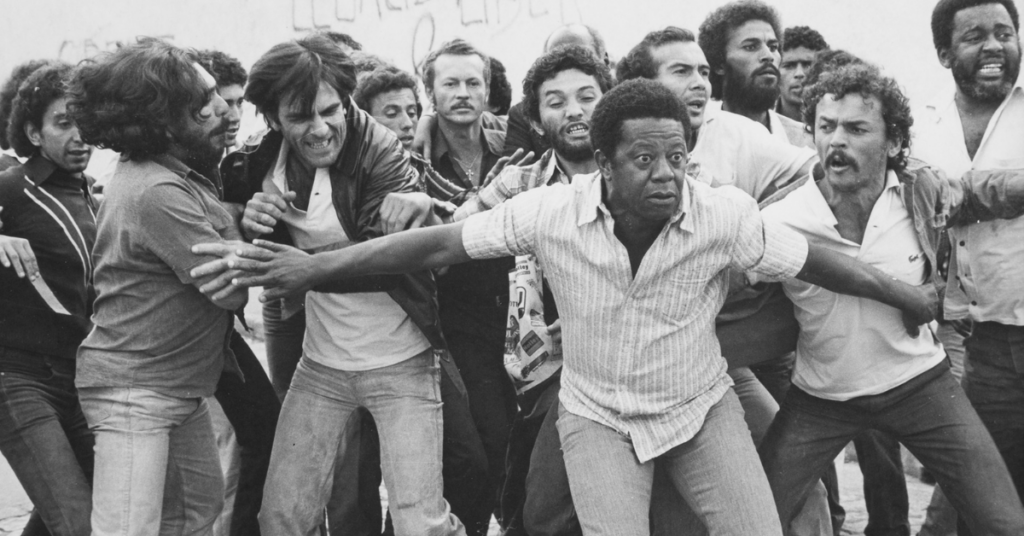
Otávio, played by Guarnieri himself, is a union leader who manages to remain idealistic while being fully aware of the world around him. His smile and friendly manner are not just the signs of a man who knows how to be part of a community; they are also ways of keeping up morale and inspiring those around him, including his son. Guarnieri played Tião in the original stage production, but here the character is embodied by Carlos Alberto Riccelli, who presents himself as someone who understands the world’s injustices but would rather adapt to them. Tião sees his father’s idealism as well-intentioned but futile, while harboring resentment over the time Otávio spent in prison years earlier for protesting against the dictatorship and its policies against the interests of the working class. He also resents the poverty and misery surrounding him, seeing the environment in which his family lives as a prison they should escape at any cost, even if some of their friends and neighbors are left behind. In short, he is a prototype of the poor right-winger who bought into the myth of meritocracy. This feeling only intensifies after two events: the announcement of his girlfriend Maria’s (Bete Mendes) pregnancy and the looming threat of a new strike organized by the union. While Otávio and his colleague Bráulio (Milton Gonçalves) understand that the strike was planned in haste and may fail to achieve its goals, their principles and class consciousness compel them to participate, even in conflict with other, more volatile union members like the fiery Sartini (Francisco Milani).
Fearing that his father’s activism will cost them both their jobs, and wanting to secure a stable future for Maria and their child, Tião begins secretly collaborating with factory management. Amid all this tension stands the figure of Fernanda Montenegro as Romana, Otávio’s wife and Tião’s mother, who tries to preserve some harmony in the household despite the escalating clashes between father and son. At the same time, she grows increasingly fearful of the path Tião has chosen for himself, one that will only lead him to alienation and loneliness.
The powerhouse cast highlights, without any didacticism, the different positions the characters hold within the context of union movements. They are symbolic figures, but never cartoonish or stereotypical, who reveal the movement as a non-homogeneous force. A plural and diverse working class that does not always agree among itself, but maintains certain basic principles. These are simple people who occupy humble homes in a peripheral neighborhood abandoned by the state, and for that very reason constitute their own only line of defense.
This sense of belonging manifests most clearly in Maria’s arc, who begins the film in a rather submissive posture toward Tião, surrendering herself to the promise of family security he offers. But she soon draws inspiration from Otávio’s ideals, rejecting Tião’s alienation, and her desire for a better life matures into a desire for a better world for all, one that can only be achieved through camaraderie and courage. Maria’s political awakening happens gradually, until she passes through a baptism of blood when the strike erupts and every character’s trajectory converges in the same moment of chaos and repression.
Hirszman’s humanist direction elegantly fits all these elements and meanings together, managing to avoid the artificial language of a soap opera while preserving the naturalness of its theatrical origins. In this way, the screenplay keeps the narrative’s point of view solely on the workers and their families, through ideological confrontations rooted in dialogue and feeling. But even the moments of silence carry tremendous emotional weight, like the famous scene with the beans at the end of the film – a final moment of lightness and hope between Otávio and Romana. The boss, the factory board, are merely invisible figures belonging to another sphere of existence. The authorities, meanwhile, the armed wing of institutions whose only concern is defending capital, remain a constant presence in the background. A constant threat of police violence, silent until it reveals itself in all its savagery during shocking moments in the narrative that make one thing clear: the defense of workers’ rights walks hand in hand with the defense of democracy.
But that is not the film’s theme. Yes, it is one of its messages, but not the main one. Nor does the film set out to be merely a cold, detailed account of São Paulo’s union movements. What motivated Guarnieri to write the original play and the screenplay for this adaptation is a deeper and more timeless truth. And fortunately, one of the easiest ways to identify a film’s theme is that the characters often say it outright. It could be one of the many moral lessons Otávio delivers to Tião, especially when he criticizes his son’s lack of vision for a better world. “You only see still water; you have to see the running water,” the father says, revealing the wisdom of age and the utopian idealism of someone who understands youth. But it becomes much clearer, as is fitting in a story of hope, that the theme reveals itself in a moment of reconciliation, when Romana tells Tião: “You’ll see that it’s better to go hungry among friends than to go hungry among strangers.”
Where to watch They Don’t Wear Black Tie:

Credits
Screenplay: Gianfrancesco Guarnieri, Leon Hirszman
Based on the play: “Eles Não Usam Black-Tie” by Gianfrancesco Guarnieri
Production company: Leon Hirszman Produções
Co-production: Embrafilme
Executive producer and production manager: Carlos Alberto Diniz
Assistant directors: Tânia Savietto, Maria Inês Villares, Mário Masetti, Fernando Peixoto, Alain Fresnot, Flávio Porto
Cinematography: Lauro Escorel
Editing: Eduardo Escorel
Production design: Francisco Osório
Set design: Marcos Weinstock, Jefferson Albuquerque
Costume design: Yurika Yamasaki
Makeup: Antonio Pacheco
Music: Adoniran Barbosa, Chico Buarque de Hollanda, Gianfrancesco Guarnieri
Music director: Radamés Gnatalli
Sound: Juarez Dagoberto Costa
Continuity: Maria Sílvia Moreira
Distribution: Embrafilme