Why we recommend it
Review
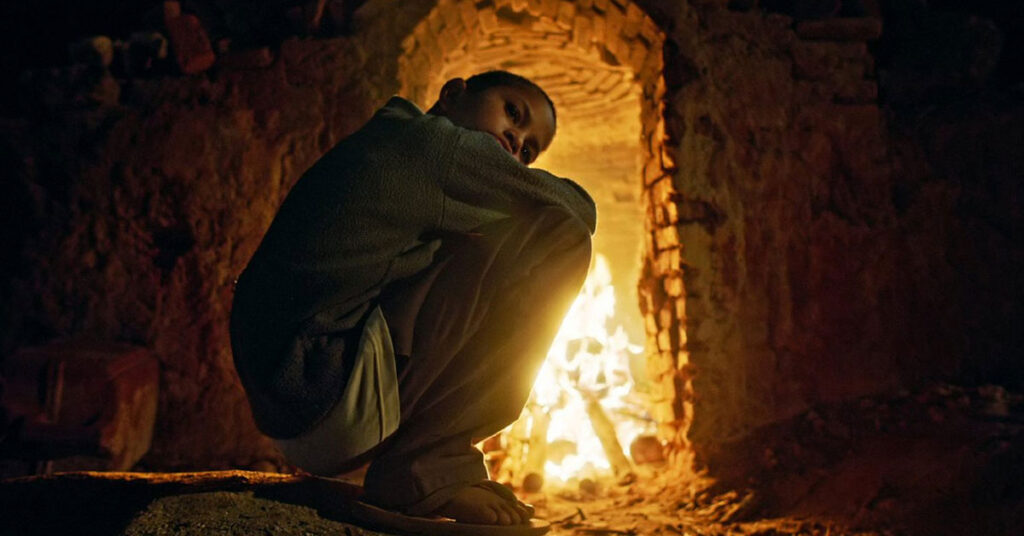
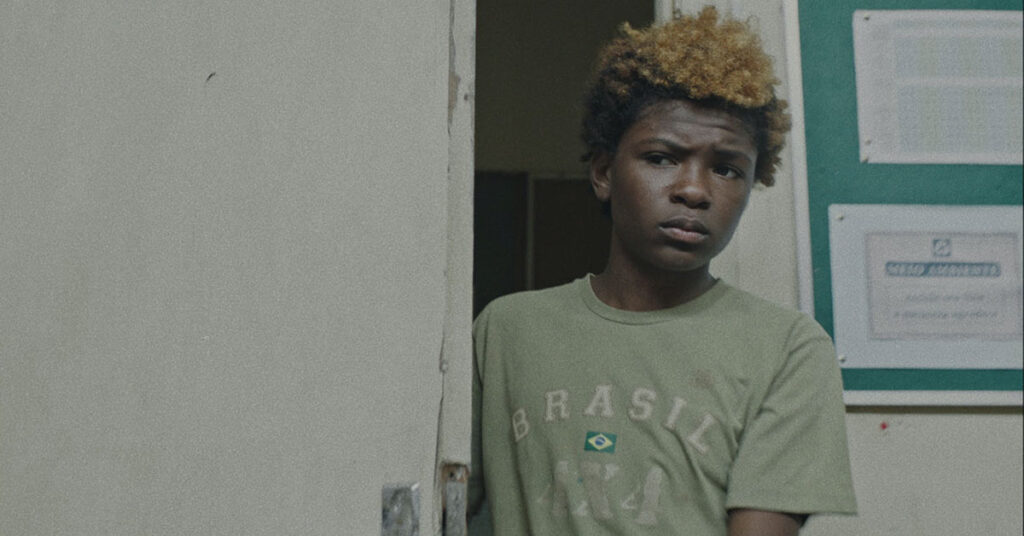
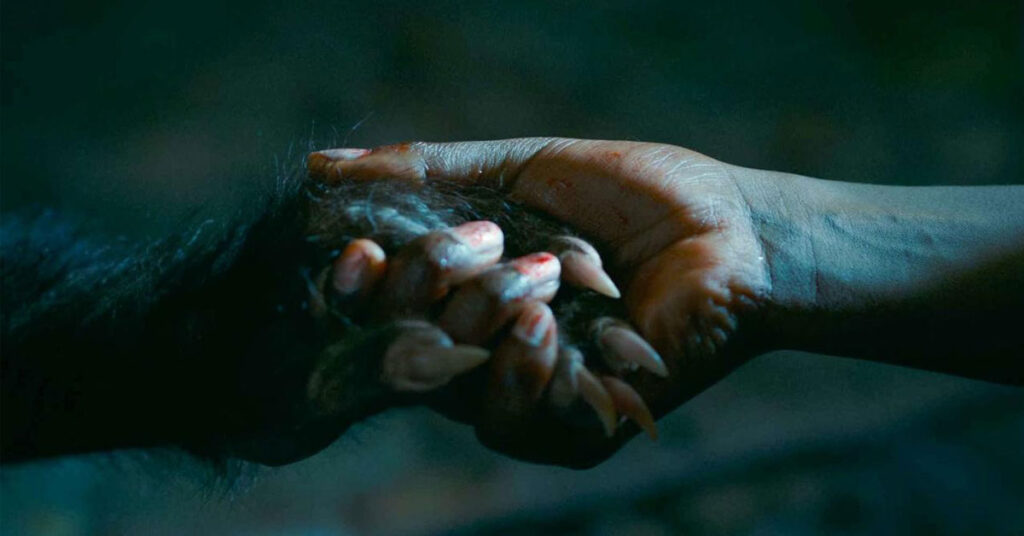
Aly Muritiba has a solid command of suspense. Over a career spanning nearly two decades, the Bahian director has demonstrated a facility for working with the basic conventions of the genre across his film and television work. His new film, “Drenched in Blood”, is yet another example of this — and a fitting addition to the filmmaker’s accomplished body of work. Based on Daniel Galera’s novel, the film tells the story of Gabriel, played by another Gabriel (Leone), who, following his father’s death, begins investigating the mystery surrounding his paternal grandfather and the man’s influence on the folklore of Praia da Armação, a fishing village on the southern outskirts of Florianópolis. But his insistence on staying in his grandfather’s old house, and his involvement with Jasmin (Thainá Duarte), a tour guide who dreams of leaving town, create growing tensions with the other residents.
These elements could already be considered genre clichés — someone travels to a remote community and uncovers a family mystery amid a threatening atmosphere — and while there are those who criticize Brazilian cinema for not leaning harder into the conventions of popular Hollywood filmmaking, the truth is that this has never held the domestic industry back. Even so, the compelling plot of “Drenched in Blood” more than earns its place, elevated by Muritiba’s style and the themes he explores. Especially when set alongside one of the director’s earlier works, the excellent “Deserto Particular,” this new film offers a clear picture of Muritiba’s personality as a storyteller.
First and foremost, both films follow similar paths in terms of aesthetics and cinematic language. The director has a clear taste for extended dialogue scenes built around long single takes in a distinctly theatrical style. There is also a noticeable preference for dividing the story into specific — and at times unexpected — segments. “Deserto Particular” opened with a remarkably lengthy prologue that stretched for half an hour before the opening credits. In “Drenched in Blood”, Muritiba chooses to divide the plot into three chapters titled The Father, The Son, and The Grandfather — with most of the scenes concentrated in the second chapter, while the first and third function more as prologue and epilogue.
Beyond all of this, the comparison between the two films reveals another notable throughline: both are distinctly masculine stories. Not in the sense of being more geared toward a male audience, but in the way they explore intimate themes of the male psyche and of men examining their own roles in society and in their own lives. The absent paternal figure who nonetheless exerts a strange influence over the protagonist, for instance, is an element common to both films. In “Drenched in Blood”, however, this theme takes on more unsettling dimensions. Gabriel represents a kind of masculinity unlike that of his father and grandfather. He tries to present himself as more modern, as someone immune to the historical legacy both men left behind. And yet he finds himself weakened after a falling-out that has cut him off from the rest of the family, and at one point he tells Jasmin that he suffers from a neurological condition that prevents him from recognizing faces.
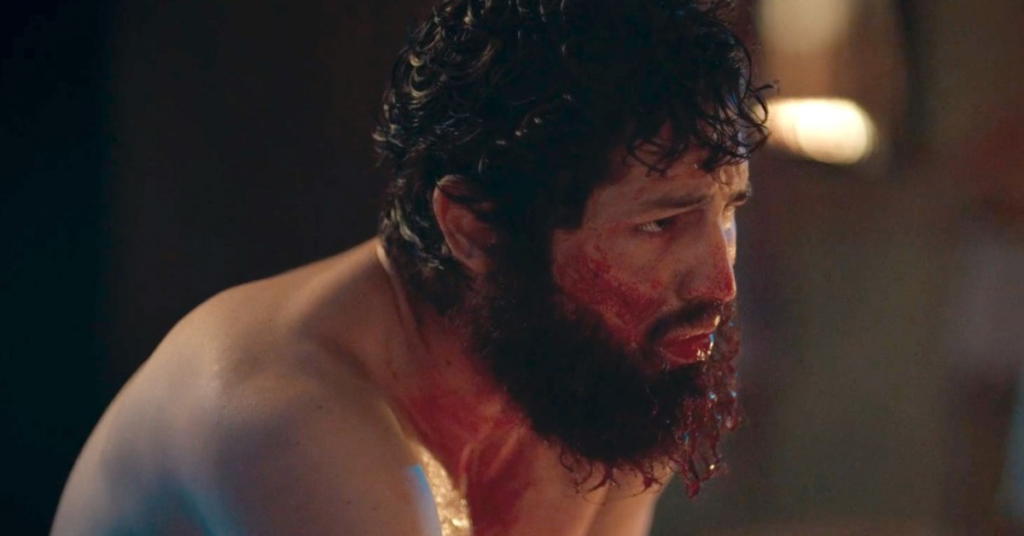
It is interesting how the director points to this narrative element through the camera’s gaze before the dialogue that reveals it — as though Gabriel’s eyes were mapping Jasmin’s face as he meets her, and as though everything around him were, in some way, strange and unrecognizable. Surrounded by uncertainty and suspicion, driven by the hostility and fear of the village’s residents, Gabriel begins to connect his questions about the legend built around his grandfather to a growing identity crisis. The viewer starts to wonder whether the character can even recognize his own face in the scenes where he looks into a mirror. Before arriving at an elegant — and even surprising — resolution, “Drenched in Blood”, in its hits and misses, lives up to its title. There was, indeed, a great deal of blood in that beard.
Where to watch Drenched in Blood:

Credits
Screenplay: Aly Muritiba, Jéssica Candal
Production: Rodrigo Teixeira, Lourenço Sant’Anna
Executive Production: Mônica Rocco
Cast: Gabriel Leone, Thainá Duarte, Roberto Birindelli, Ivo Müller, Ricardo Blat, Teca Pereira
Cinematography: Inti Briones
Production Design: Ana Paula Cardoso
Editing: Karen Akerman
Location Sound: Douglas Vianna
Sound Design and Mixing: Daniel Turini, Fernando Henna e Henrique Chiurciu
Score: Beto Vilares, Érico Theobaldo
Hair and Makeup: Andrea Tristão
Costume Design: Diogo Costa
Production Company: RT Features
Co-production: Globoplay
Distribution: O2 Play
Country: Brazil
Year: 2026
Runtime: 108 min.
Genre: Fiction
Rating: 14+