This review is part of Tropical Alien’s coverage of the 50th São Paulo International Film Festival.
Why we recommend it
Review
In a distant future, after some great apocalypse has wiped out almost every trace of our current world, a tribe of post-humans survives in a vast desert around an enormous inverted mountain. In the Village of the Present, this small society driven by a belief in giants who live in the clouds, young Hanabi waits for the moment she can ascend to a new level of the mountain. But when her best friend Quingu moves on to this new stage before her, Hanabi breaks the tribe’s rules to follow her. And when she is discovered, the guardians sentence her to exile.
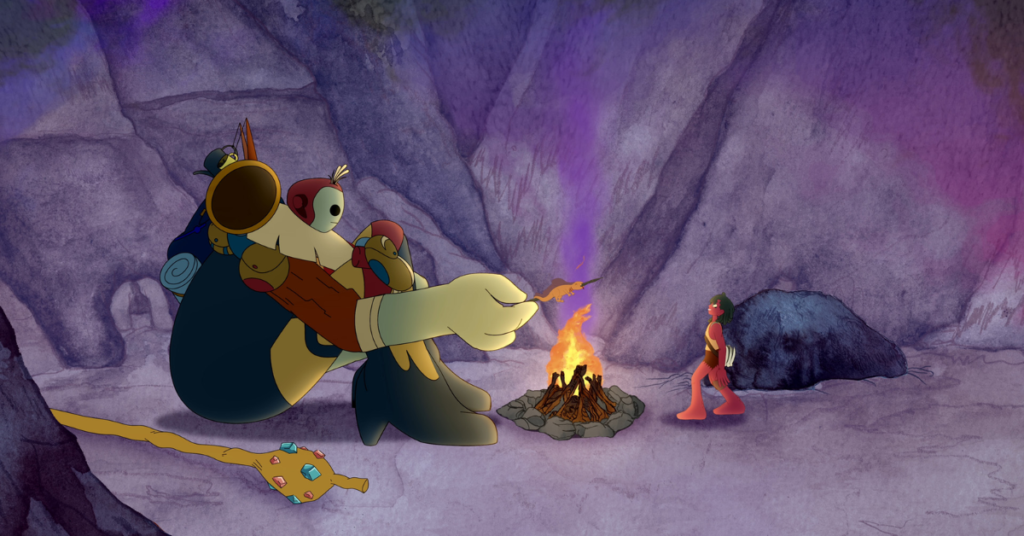
This is the premise of Giants Hideaway, the first feature by filmmaker Bárbara Cabeça, which premiered at the 50th São Paulo International Film Festival. In adapting the play of the same name by Inquieta Cia., the director expands on the themes of the original text, which focused more on Hanabi’s relationship with the mysterious Bonjongo – presented here as a giant she meets in exile – and offered a beautiful portrait of friendship between two people from different cultures. That element is still present in the film, but the story expands the lore of that world, populating it with diverse, colorful characters and mysterious concepts that make that setting intriguing, at once more fantastical and more tangible.
Take the concept of “gigantuar”, the process by which Hanabi’s people rise from level to level until they become giants and earn the right to reach the Village of the Future at the top of the mountain, but which, in the context in which it is presented, seems to be nothing more than the act of growing up naturally, turned here into dogma. Or the “Keys of Tomorrow”, special staffs used by the guardians that seem to carry some symbolic meaning of power and authority, yet have the apparent shape of a rifle. In this vein, there are also the giant bats that inhabit the mountain, which at first seem to be wild predators but later appear ridden by mysterious masked figures. The film is ingenious in presenting these elements without falling into the temptation of overexplaining, leaving many interpretations of that world’s rules and beliefs open.
But the real ace up the sleeve of Giants Hideaway is its young voices. In the sense of being the work of a first-time director backed by talents eager to show a refreshing take on a concept that has been widely used. But also in the literal sense. The young voice cast – made up of Jéssica Cruz, Hanna Nascimento, Melindra Lindra, Tina Reinstrings, Gyl Giffony, Jupe Vasconcelos and Maya Vic – delivers naturalistic performances that stand out from what Brazilian audiences know of voice actors. While Brazilian dubbing tends to seek a regionally neutral sound, the cast of Giants Hideaway celebrates the accent of Ceará, in Brazil’s Northeast, with the simple joy of communicating just as they are. In a market populated by studios from the Rio-São Paulo axis, the arrival of a film like this, made by professionals from the Northeast, is more than welcome.
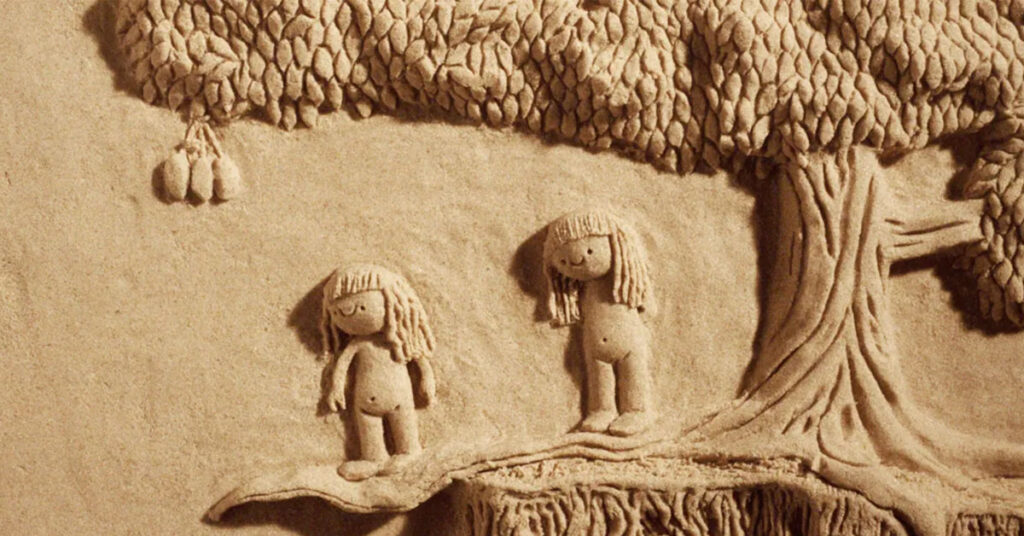
This gathering of young talent under Bárbara’s direction is also apparent in the visuals and animation techniques of the film, which resembles a patchwork quilt. 2D characters created and animated digitally inhabit analog settings, made with classic techniques and media such as chalk and watercolor. The director used the word “translation” to describe the process through which this blend of techniques reached the final product, turning budget limitations into visual language.
Combined with the plot’s original approach, this look lets us compare Giants Hideaway with other animated films. Titles like Watership Down (1978), Son of the White Mare (1981), Epic (1985) and The Last Unicorn (1982) are cult animations, produced outside the familiar standard of the big studios in the US and Japan. They may not be known to the general public, but they are the favorite animated films of your favorite directors. And so, if our own future doesn’t turn post-apocalyptic, you can imagine future generations of Brazilian animation professionals looking at Giants Hideaway with the same level of respect and affection.
Where to watch Giants Hideaway:

Credits
Writers: Bárbara Cabeça, Petrus de Bairros
Production Company: Costa Barros Produções
Editing: Bárbara Cabeça, Petrus de Bairros
Production Design: Daniel Chastinet
Music: Clau Aniz, Mariah Duarte, Amrita Jones
Sound: Letícia Belo
Distribution: Lambeolhos Produções