This review is part of Tropical Alien’s coverage of the 50th São Paulo International Film Festival.
Why we recommend it
Review
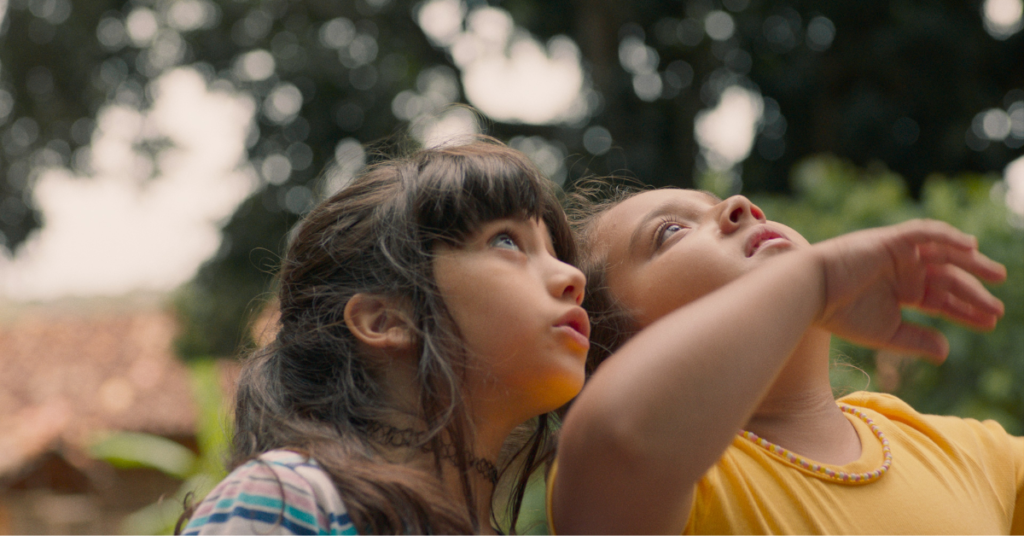
With a title like The Nature of Invisible Things, the first feature written and directed by Rafaela Camelo invites us to ask: what is the nature of what is invisible? How are we affected by what we can’t see? Subtly, the film’s plot delves into these questions as it introduces its two protagonists, the girls Glória and Sofia, and gradually reveals the details of their lives. At ten years old, Glória (Laura Brandão) seems isolated from other children and, when she’s not at school, spends most of her time under the overprotective watch of her mother, Antônia (Larissa Mauro), who works as a nurse in a hospital. Doted on by the bedridden elderly patients who live in the building, Glória finally finds a companion her own age when she meets Sofia (Serena), who arrived at the hospital with her great-grandmother Francisca (Aline Marta Maia), and in the absence of her mother, Simone (Camila Márdila). Sofia believes her great-grandmother’s condition will only improve once Simone agrees to take her back to her farm in the countryside. And when the two mothers also form a bond of friendship by sharing their experiences, Antônia offers to go along and help Simone care for her grandmother, which also gives Glória the chance to get some fresh air and strengthen her friendship with Sofia. But beyond her worry over her great-grandmother and the friction with her mother, Sofia still has to deal with the painful memory of a boy named Bento, something she begins to make sense of through her family’s religious practices and spiritual traditions.
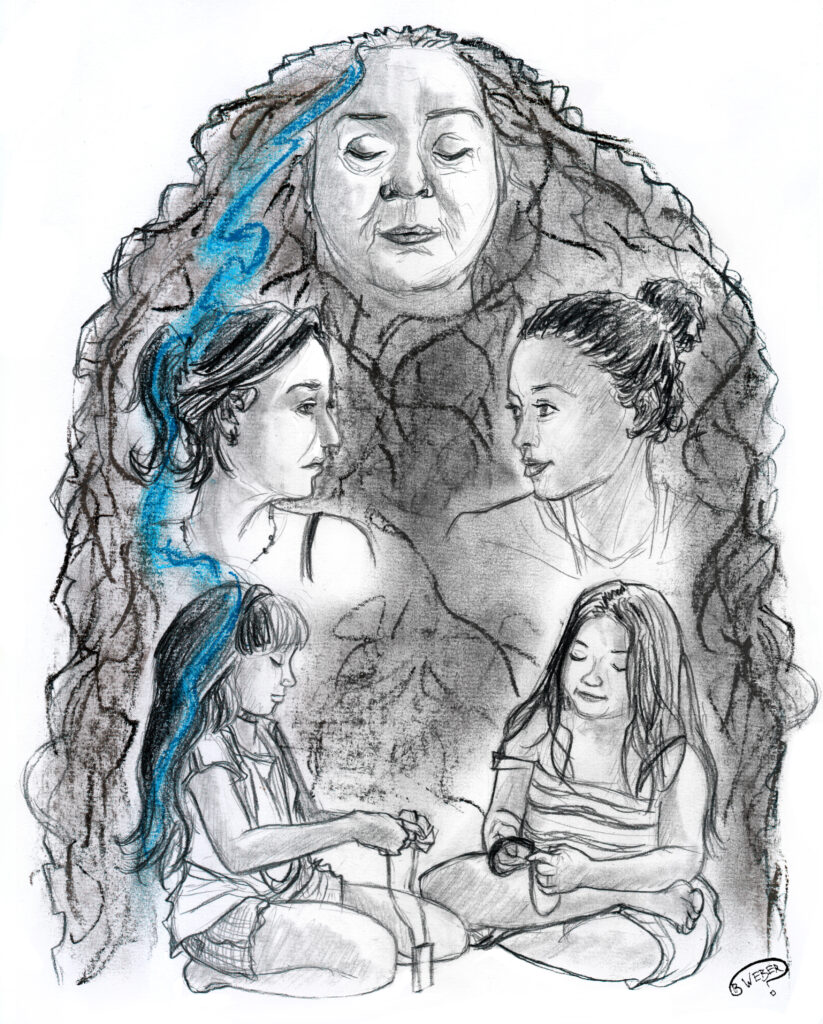
The parallels between the two girls and the two mothers make room for this beautiful connection to form naturally between them. Simone and Antônia, single mothers, responsible for children whose particularities keep them somewhat apart from the rest of the world. In both cases, daughter and mother need a kind of care that only outside relationships could offer. There are also parallels in the film’s setting, which moves from the hospital to the farm, two very different places of healing that complete each other. If the hospital was where the two friendships took hold, it’s at great-grandmother Francisca’s farm that the four characters find ways to resolve their troubles. Populated by a community of women, neighbors and cousins who keep alive ancestral practices of alternative medicine combined with the traditions of folk Catholicism, the farm helps Simone and Sofia reconnect through the love they share for Francisca. And it’s interesting to note how the production design reinforces this family bond. Sofia, Simone and Francisca all have a streak of hair dyed blue – the same blue that stands out in the farm’s setting – a resemblance that points to a strong connection, despite their differences and friction. The great-grandmother does begin to improve after they arrive, while at the same time preparing for an inevitable end with calm and even joy.
What’s more, while the hospital was where Glória told Sofia she had recently had a heart transplant – the reason Antônia is so controlling with her daughter – it’s at the farm that Sofia shares with Glória something she had been afraid to tell. And from here on this text will discuss spoilers about the film’s plot… Then again, no, right? A film like this doesn’t need to worry about spoilers, this isn’t some Marvel action-figure movie. Sofia tells Glória that she’s a trans girl, and that Bento was the name she was given at birth. As happens with many people who go through gender transition, Sofia suffers from the lingering traces of who she was before, like photos, mentions of her deadname or awkward questions. But in the end, it’s in this reconnection with her mother through her great-grandmother’s faith that Sofia receives the balm to ease that pain. This happens in one of the film’s most tender moments, when the look exchanged between Sofia and Simone says as much as their words, culminating in a kind of reinterpretation of the tradition of “encomendação da alma” (the commendation of the soul), a funeral rite brought to Brazil by Portuguese Jesuits. And after that, Sofia’s character arc closes in a very simple and elemental way when we notice the two different ways she treats a photo of Bento. In fact, for a film with such a talented cast – especially the children – and such well-crafted dialogue, it’s remarkable how much it expresses solely through images and what doesn’t need to be said.
Taking all these elements of plot and character into account, perhaps the invisible that Rafaela Camelo refers to in the title is the irrelevance of the differences between Glória and Sofia, as invisible as the differences between the two of them and any other girl. They’re both just normal kids, who found in each other the trust and safety to behave as such. Or the invisibility of the suffering shared among women, which Simone and Antônia instantly recognize in each other. But all of this relates to the idea of another invisible world, a spiritual universe that may not exist factually, but that lends itself to helping and explaining the physical world, if we need it to. The way Sofia manages to embrace both her family’s spiritual heritage and her gender identity shows how traditions don’t need to oppose change, but should sustain it, the same way a mother protects and nurtures a daughter. Change is the most human quality of all, and perhaps trans people embody it more than anyone. And so we discover that the people we once were and left behind, like those who die, can be kept as memories, and fondly.
Where to watch The Nature of Invisible Things:

Credits
Director and Writer: Rafaela Camelo
Cinematography: Francisca Sáez Agurto
Editing: Marina Kosa, Rafaela Camelo
Music: Alekos Vuskovic
Sound Design: Lucas Coelho
Production Design: Sarah Noda
Producers: Daniela Marinho, Rebeca Gutiérrez Campos, Otavio Chamorro, Rafaela Camelo
Executive Producers: Heloísa Schons, Juliana Melo, Isabella Jacob Pinto, Daniela Marinho, Fred Burle, Rebeca Gutiérrez Campos
Casting: Guilherme Angelim, Nathalie Amaral, Daniela Vasconcelos
Production Company: Moveo Filmes
Co-production: Pinda Producciones
Distribution: Vitrine Filmes
Running Time: 90 minutes