Why we recommend it
Review
Childhood is one of cinema’s central themes. There is a nostalgic mystery to the figure of the child that, beyond interest and wistfulness, also stirs a kind of wonder in the adult gaze. Because of that, it tends to be a somewhat invasive perspective, an outsider’s view of a child’s world, coming from someone who watches from a distance, aboard a ship that set sail long ago and keeps drifting further away at a steady pace. Portraying a child’s perspective on the world, then, is no easy task for any director. In the case of a documentary filmmaker like Eliza Capai, who is dedicated to social issues and to telling the stories of people facing some degree of vulnerability, the most direct approach to childhood is also the most obvious one: let the children speak for themselves. In The Fabulous Time Machine, her latest film, the director turns her attention to a group of girls from the municipality of Guaribas, in the far southwest of Piauí. The arid, unforgiving landscapes surrounding the small town evoke, in metropolitan minds, the kind of imagery of hardship and isolation that today amounts to an incomplete caricature of Brazil’s Northeast. But the director breaks that expectation after just a few scenes with her protagonists, revealing them as something more than illustrations for a sociology lecture. The girls of Guaribas are simply children.
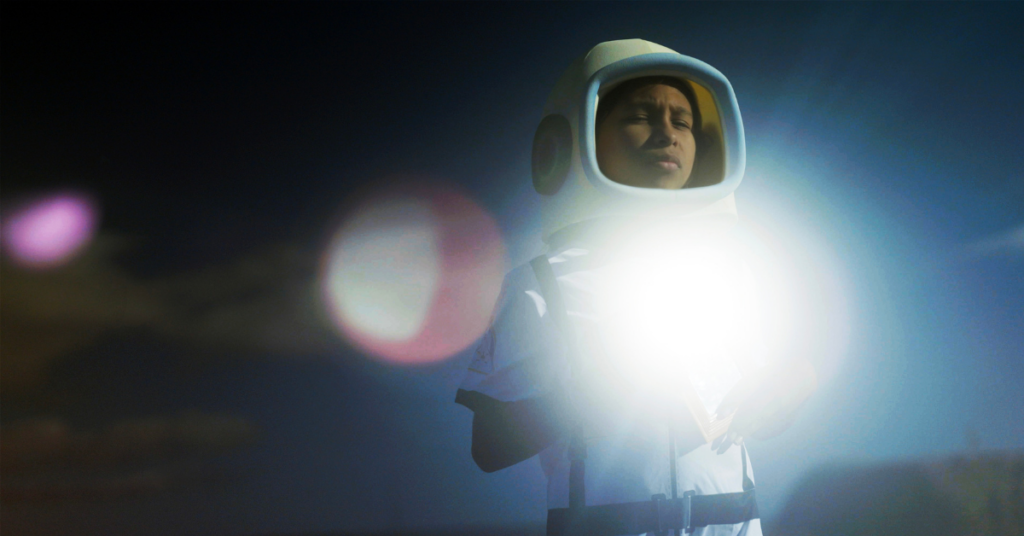
Unlike the time frame and sense of agency found in the portrayal of other children captured by Capai’s camera, the public school students protesting school closures in her 2019 film Espero tua (Re)volta, the message carried by the girls of The Fabulous Time Machine lies in their ordinariness. We follow them through their daily routine of games, classes and chores, moments marked by small kindnesses and minor squabbles. The typical silly conversations of a youth with no notion of the charm they hold for adult ears. The director’s passivity toward these characters is more than a device that lets them behave naturally in front of the camera. It is, in fact, an invitation. So much so that Capai hands over her own toys to them: filmmaking equipment and the language of cinema itself. As a result, the girls create and star in several short films of their own, giving shape to the ideas and questions that arise from their interactions. This is also where the image of the time machine comes in, as the girls’ fantasies inevitably lead to the film’s key question: “if you had a time machine, would you want to go to the past or to the future?”
The girls ask each other this question, and they ask their mothers too, in moments when, still within the game, they take on the role of interviewers. It is a question that reveals something they share among themselves, and that their mothers felt as well at that same age. A mix of curiosity and apprehension about the adult world, a reality that seems predominantly shaped by men. They wonder about future boyfriends and husbands, while one of the mothers says that, given the chance, she would go back to the past and do a few things differently, perhaps not getting pregnant so young. These conversations illustrate how childhood innocence, which carries within it an eagerness for adulthood, is gradually smothered by the disillusionment of its approach.
At one point in the film, one of the few male figures to appear takes the grotesque shape of a drunk man playing with a snake’s carcass. The girls promptly try to make sense of it through one of their shorts, imagining what that man’s wife might be like. Capai makes no attempt to romanticize the girls’ circumstances, keeping in plain view real threats to their well-being, such as alcoholism, neo-Pentecostal conservatism and early sexualization. Even so, things could be much worse. The film makes clear how social programs like Bolsa Família have led to a remarkably significant rise in literacy rates among Guaribas’s children. That shift is also reflected in how many of the stories of violence and misogyny the girls repeat among themselves start to feel a little more distant. They are not entirely safe. But for now, they get to just be children.
Where to watch The Fabulous Time Machine:

Credits
Cast: Alice, Ana, Ana Vitoria, Joice, Laiane, Larissa, Laura, Lorenna, Manu, Manuellinha, Safira, Sophia, Thaemmy, Thabata
Director: Eliza Capai
Produced by: Mariana Genescá
Editing and Screenplay: Daniel Grinspum and Eliza Capai
Cinematography: Carol Quintanilha
Location Sound: Luisa Lemgruber
Executive Production: Mariana Genescá
Production Management: Clarice Rios
Executive Production Assistant: Jac Melo
Original Score: Décio 7 with special participation by Juliana Linhares
Sound Design: Daniel Turini
Sound Supervision: Marília Mencucini
Sound Mixing: Julia Teles
Colorist: Maisa Joanni
Post-Production Coordination: João Gila
Credits and Poster Design: Joana Amador and Fiteiro
National Distribution: Descoloniza Filmes
International Sales: Split Screen