Why we recommend it
Review
Political polarization is not exclusive to Brazil. If you’ve followed the last decade of news on any Western democracy, you’ll recognize the pattern. As one of the direct results of the information crisis, the far right has risen everywhere, riding a steadier wave of politicized discourse across every layer of society. But Brazil still does things its own way. Brazilian extremists seem to have leaned even harder into a caricature of themselves. The ridiculous became aesthetic, and the absurd became routine. Here, Jair Bolsonaro’s supporters pray to a tire in the middle of the highway, drink cleaning detergent, and get furious at flip-flops. Even though these phenomena have only gotten worse over the years, the truth is we’re already used to them. That’s just how things are now. The political sphere is infected by the performance of absurdity. It was only a matter of time before artists started digging into it. Enter “Eu Não Te Ouço.”
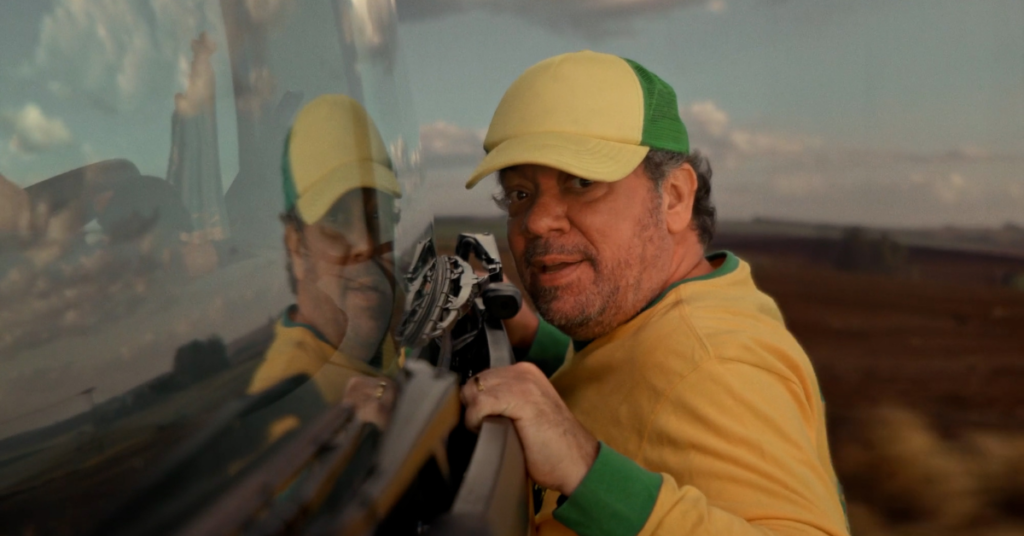
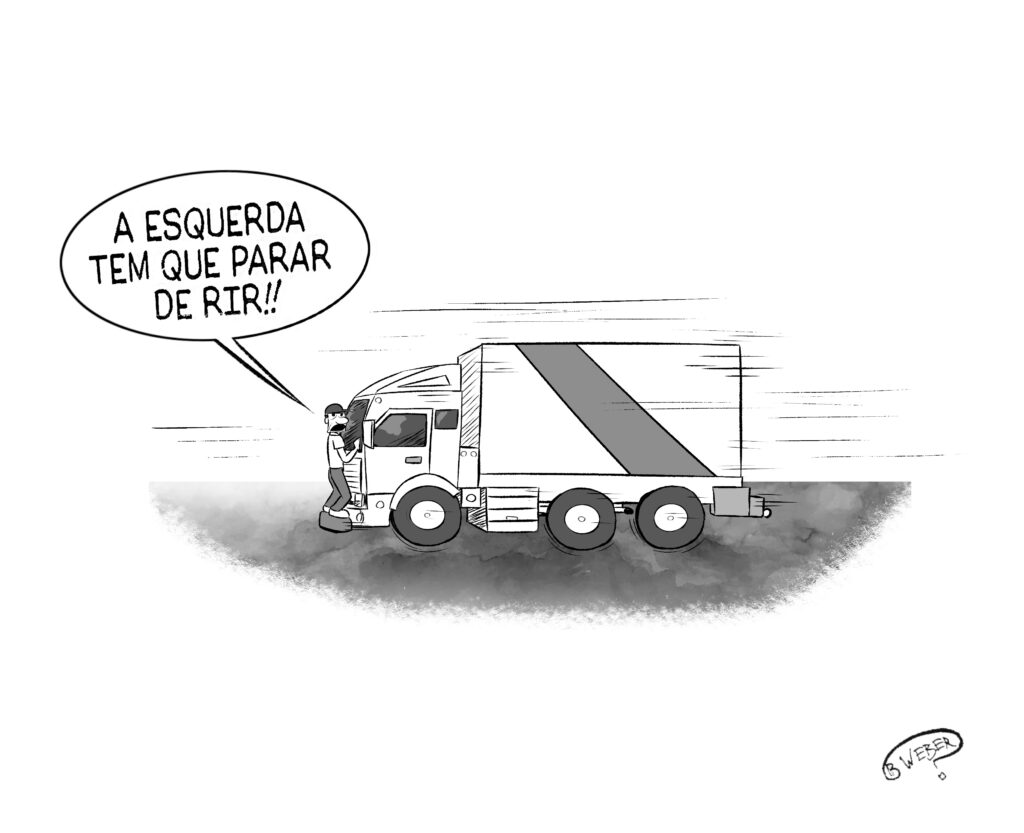
The new work from actor and director Caco Ciocler directly references an infamous (or bizarre?) moment from the protests that followed Bolsonaro’s defeat in the 2022 election. Bolsonaro supporters in Pernambuco blocked the BR-232 highway in support of an attempted coup. One of the protesters tried to stop a truck from passing through the blockade by climbing onto the bumper and clinging to the windshield. The driver, however, didn’t stop, and drove several kilometers with the self-proclaimed “patriot” hanging off the front of his truck. The story went viral, obviously, not just as a portrait of an extremist movement growing exponentially desperate and dangerous, but also because the footage was hilarious, practically born to become a meme. Three years later, Ciocler’s film draws from that event to retell the story from both perspectives: the patriot’s and the trucker’s.
Better known as an actor, Ciocler’s directing career includes titles like “Esse Viver Ninguém me Tira” (2014) and “Partida” (2019), documentaries that lean heavily on dramatization and on the act of performing a true story to deliver an openly political message. And even though “Eu Não Te Ouço” is his most fictional work to date, it carries traces of that same approach, both in how it dresses itself in the language of a fake documentary, complete with an invisible film crew interviewing the two characters, and in how it leans entirely on the performance of actor Márcio Vito, who takes on the dual role of the driver and his unwilling passenger. Vito’s performance is the film’s standout achievement, playing two deeply opposed men through a sequence of long monologues defined by their inability to interact with each other, not just because of the physical barrier of the windshield, but the ideological one too. Both the performance and the makeup work do a great job building these two characters, to the point that I hadn’t realized, in the film’s first few minutes, that I was watching just one actor. The man driving the truck is portrayed through the romanticized image of the trucker: a free man gifted with simple wisdom, an individual proud of his work, honest and direct in his convictions. The patriot hanging off the truck, meanwhile, is the fully realized caricature of the far-right fanatic, a prisoner of his own ideological delusions, a victim of a hero complex that led him to join an antidemocratic movement and put his own life at risk (unlike the real man who inspired him, this patriot doesn’t get down from the truck when the driver warns him he’s about to stop). Even so, he isn’t dehumanized. There are several moments where it’s impossible not to feel pity, even sympathy, for someone so manipulated.
The film’s minimalist approach, focusing on these two men’s testimonies through the language of a mockumentary, is at once its greatest strength and its greatest flaw. The premise is unusual and engaging enough to justify the film’s existence, and the director’s artificial framing highlights the absurdity of the situation while amplifying its most surreal moments, particularly a striking reveal near the end. It’s debatable, though, whether the plot manages to clearly capture the country’s polarized political landscape. After all, this is a clash between a self-declared fanatic and a “normal” man. The trucker is portrayed as someone uninterested in politics, absorbed in his routine and his duties to work and family. The actual militant left is absent from the film, showing up only in the patriot’s delusional rants about it. That wouldn’t be fixed just by having the trucker reveal a CUT cap stashed in his glove compartment. To build a more relevant portrait of the left in a film like this, Ciocler would have needed to be willing to laugh at himself too.
In the end, working more as a philosophical thesis or an acting exercise than as a film, “Eu Não Te Ouço” gets lost in its own seriousness. The director said in a recent interview that “the left needs to stop laughing.” According to him, the film’s goal is to make clear our need to pierce through the veil of polarization. “Why did I stop laughing at that meme? Because I understood it was a very concrete symbolic representation of an inability we were living through: the inability to listen to each other.” And maybe that’s true. But this is still a story about a guy who stood on the bumper of a truck trying, unsuccessfully, to stop it from driving away. If there’s a film that should have been an outright comedy, it’s this one.
Where to watch Eu Não Te Ouço:

Credits
Screenplay: Caco Ciocler, Isabel Teixeira and Márcio Vito
Production: Diane Maia, André Novis and Caco Ciocler
Associate Production: Fernando Palermo, Carlos Vecchi and Eduardo Nasser
Executive Production: Carlos Eduardo Valinoti
Cinematography: André Faccioli
Production Design: Marcelo Escañuela
Editing: Caroline Leone
Costume Design: Mel Akerman
Hair and Makeup: Fernando Andrade (Feco) and Ravena Corre
Production Management: Paula Madureira
Location Sound: Ubiratan Guidio
Sound Mixing: Toco Cerqueira
Sound Design: Mariano Alvarez
Original Score: Arthur De Faria, Mauricio Pereira and Felipe Pipo
Production Company: AMAIA
Co-Production Companies: UNO Filmes, 555 Studios and SCHIFIGUER
Cast: Márcio Vito, Caco Ciocler