Why we recommend it
Review
Jorge Furtado’s comedies, both written and directed by him, tend to share a few things in common. The gaúcho filmmaker has a fondness for chronicling the misadventures of groups of cheerful misfits, brought together by some shared goal. His dynamic, lively writing still manages to carry real emotion, grounded in an obvious affection for the characters he creates, characters who can be exaggerated, but never turn into caricatures. The result is a deeply human kind of comedy, populated by the sort of joke you’d share with friends recounting your day. But even with these familiar elements in place, My Pleasure, Furtado’s latest film, ends up having a closer kinship with Saneamento Básico – O Filme, one of the director’s most popular works. That’s because the 2007 film, starring Fernanda Torres and Wagner Moura, also shares that same sense of discovering the power of the recorded image, the thrill of being both in front of and behind the camera.
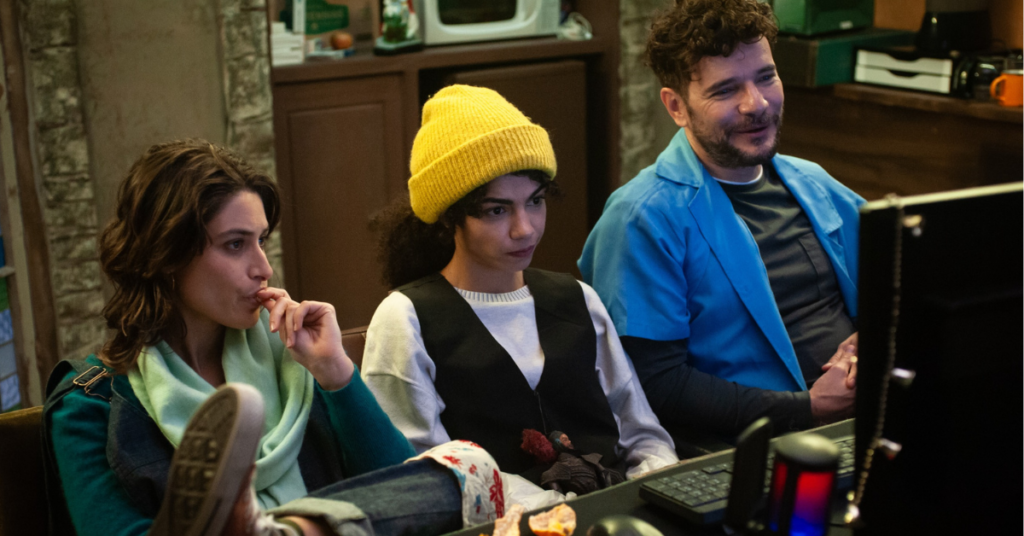
In My Pleasure, Daniel de Oliveira plays Rubem, a lonely man buried in financial trouble. After his uncle’s death, he inherits the Pérola Motel, along with all the debts accumulated over the years. There he meets Grace (Luisa Arraes), his uncle’s only employee, who has been secretly living in one of the rooms since the motel closed down. Once he realizes selling the property is out of the question, Rubem decides to reopen the motel with Grace’s help. Even so, they can barely cover the bills. Until, partly out of boredom and partly out of curiosity, they start secretly filming guests and selling the videos on adult content sites. For that, they rely on the tech and internet know-how of Nalva (Samantha Jones), and the three of them start splitting the profits from this risky scheme, all while debating just how far they’re willing to push the ethical line.
Truth is, the film doesn’t dig very deep into these debates. There are moments when the conversations between Rubem, Grace and Nalva touch on more interesting arguments about the harms of the pornography industry, about people’s relationship with sex, and with images of sex, or about the very nature of identity in a digital environment. If on one hand Grace insists “we’re not hurting anyone,” since they go to great lengths to fully hide the identities of the people they film, on the other, they’re fully aware that getting caught means jail time.
Looking to protect the guests’ identities even further, and to make more money selling videos where faces aren’t blurred, Grace asks Nalva to digitally superimpose her own face onto the women in the footage, which raises some intriguing questions about sexuality as performance. Early in the film, Grace seems to lean toward asexuality, but the truth is she’s quite interested in the idea of sex and its imagery, she just doesn’t want to have it herself. In this way, the film seems to argue that pornography, the basic concept, beyond the industry built around it, can hold some value, for all its problems, in enabling expression and self-discovery. At a moment when some people are starting to reject any graphic depiction of sexuality, that could have led to some invigorating discussions.
But it doesn’t, really. Maybe Furtado felt that a sharper examination of the immorality behind the trio’s actions would risk the audience’s affection and empathy for them. Or maybe he simply set out to make an easy-going comedy where you can spend an hour and a half without any real commitment.
On that front, the film succeeds. Watching My Pleasure, you can tell it’s a film made with real joy, the kind of project a filmmaker puts together with friends, and one that seems to invite the audience to share in that same feeling. Not just because of the director’s familiar comedic approach, but because it leans on the good chemistry between its cast. The three lead actors are all excellent, each supporting the others’ work. Daniel de Oliveira plays Rubem as the typical bumbling, somewhat naive protagonist; Samantha Jones brings a sharp cynicism and pragmatic edge to Nalva; but it’s Luisa Arraes who steals the show as Grace. Even with her charmingly odd mannerisms, like comparing people to clouds, she avoids the “manic pixie dream girl” stereotype by having an arc of self-discovery that actually drives the plot forward.
And when the inevitable romance between her and Rubem starts to bloom, it feels like a natural conclusion, even if it’s portrayed as something of a cliché, complete with two montages of the moments they share together, one of them set to the song “Quem É Do Amor,” by Sérgio Sampaio, in a sequence that looks straight out of the final minutes of a Brazilian soap opera.
Furtado’s screenplay also impresses by feeling genuinely plugged into the language and current habits of social media, showing an awareness of that digital environment without ever feeling forced, something I don’t remember seeing in a recent Brazilian production. Frankly, just the fact that Furtado casually name-drops Bluesky and Koo in a piece of dialogue already shows a deep understanding of Brazilian internet culture. In the same way, he manages to reference the countless categories of sex and pornography that the internet has revealed or created over the past few decades, almost like a new territory the characters need to learn to navigate. There’s even a direct nod to an ad for the online betting platform Brazino, which pops up before porn videos on some sites, a moment that got quite a few laughs from the audience at the screening I attended. So yeah, they all got it. Cheeky bunch.
Where to watch My Pleasure:

Credits
Director and Writer: Jorge Furtado
Executive Production: Nora Goulart
Cinematography: Lívia Pasqual
Editing: Giba Assis Brasil
Production Design: Fiapo Barth, Dayane Paz
Costume Design: Rosângela Cortinhas
Casting: Daniela Silveira
Production Management: Glauco Urbim
Location Sound: Rafael Rodrigues
Makeup: Jojo Silveira, Juliane Senna
Original Score and Performance: Maurício Nader
Sound Design: Kiko Ferraz, Ricardo Costa
Cast: Daniel de Oliveira, Luisa Arraes, Samantha Jones, Felipe Velozo, Drica Moraes, Catharina Conte
Production Company: Casa de Cinema de POA