Why we recommend it
Review
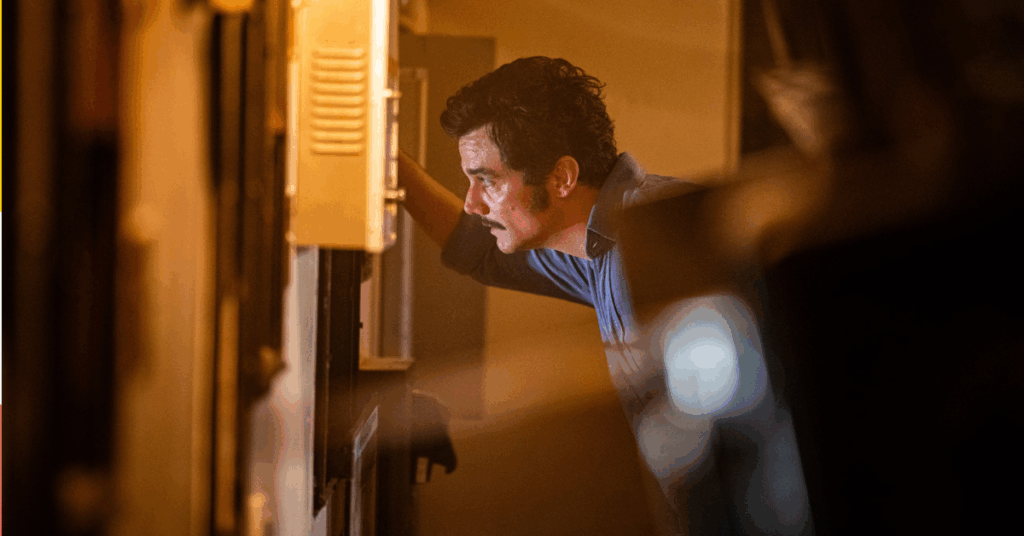
In “Pictures of Ghosts”, a documentary Kleber Mendonça Filho released in 2023, the director creates a clear image of his memories of the city of Recife, familiarizing the audience with the streets, culture and history of the capital of Pernambuco. He does this using the history of the city’s street cinemas as his main theme, creating a direct relationship between those old buildings, the classic films that were shown there and the people who frequented them. In KMF’s cinema, memory is a mosaic of old media. This becomes even clearer in his new film, “The Secret Agent”, which alongside “Pictures of Ghosts” seems to form a duet project, with their themes complementing each other.Thus, before introducing us to the colorful environment of Recife in the seventies (a time full of mischief, as the opening text describes), the film takes some moments to display black and white photos of Brazilian celebrities of the era. From Os Trapalhões to Caetano Veloso, the narrative of “The Secret Agent” thus establishes its time frame, when these were the faces everyone knew, the voices everyone heard, the stories everyone followed. On the radio, on TV and, especially, in the cinema. When protagonist Marcelo’s yellow Beetle enters the scene heading toward Recife during Carnival season, we follow the journey already fully acclimated to that time and place. Our gaze becomes complicit with Marcelo’s, and we begin to know the character through his perspective. The praise Wagner Moura has been receiving for his performance in this film is more than deserved. In perhaps his best work to date, he gives Marcelo the air of a man in constant state of alert, already accustomed to hiding his fears and afflictions behind a calm appearance, adorned with swagger and style. After arriving in Recife, we gradually understand Marcelo’s real situation when he takes shelter in the Edifício Ofir and meets his new neighbors. Managed by Dona Sebastiana (played by the impressive Tânia Maria, one of the film’s gems), the place serves as refuge for people who need to hide from some kind of persecution. Marked for death, immigrants, activists – people the military dictatorship classified as inconvenient or simply disposable, unworthy of any protection. Marcelo is one more of them.
Or rather, Armando, which is his real name. Like everyone in the building, he had to assume a new identity, while seeking to start a new life with his son Fernando, who has been living with his grandparents since his mother died. And from there, the way KMF constructs narratives makes “The Secret Agent” have a singular approach to what could be called a “dictatorship story”. Unlike “I’m Still Here”, for example, there isn’t the same historical commitment or presence of the people involved, which would require a certain narrative formalism. This allows the story to present itself subjectively before showing the facts. And it does this through very strong visual language. The corpse beside the gas station, the bloodstain on the policeman’s uniform, the reveler’s costume on the roadside, the dead shark with a human leg in its stomach. These are elements that appear on screen bordering on the surreal, creating a delirious aesthetic, but full of meaning. Another example of this is Elis and Elisa, a deformed kitten that Dona Sebastiana adopted because it would be sacrificed and became the mascot of Edifício Ofir. Like all the building’s inhabitants, it’s a creature with two faces and two names, and only within those walls and corridors has any chance of survival. The film is full of characters who need to maintain two faces and play two roles. As if the act of performing, beyond a defense mechanism in those dark times, became a state of mind.
Another way in which “The Secret Agent” differentiates itself from other dictatorship stories is that it doesn’t worry so much about directly portraying the comings and goings of the political environment and the State’s repression tactics. Marcelo and his family didn’t become targets for militating against the dictatorship. They simply irritated the wrong person, a rich businessman with powerful connections in the government. The dictatorship created a large ecosystem of systematic political repression throughout the country’s territory, and at the same time empowered an enormous fauna of petty wretches, men with fragile egos and unlimited means. But the main theme of “The Secret Agent” and the greatest argument it makes about that period of Brazilian history come when the film reveals a framing device. The entire story of Marcelo/Armando is being “discovered” in present day by two university researchers, played by Laura Lufési and Isadora Ruppert, who are investigating the content of cassette tapes made available to their college’s collection. While the Brazilian business-military dictatorship acted directly to erase stories, it’s in the permanence of physical media that they can be resurrected.
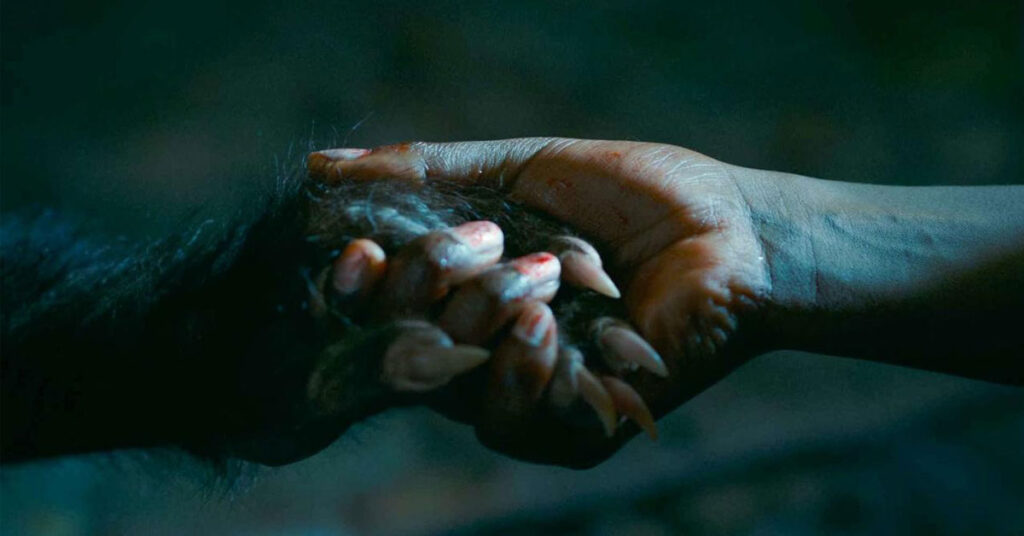
Again, it’s the recording of image and audio that connects the past to the present. The narrative and visual rhymes that permeate the film are another sign of this. The mythological monsters represented by the shark and the hairy leg gain more strength when they become printed news in the newspaper or an animated cartoon on TV, even if they represent only distant fragments of the truth. Even the film’s title, “The Secret Agent”, which promises a basic spy story, has this meaning subverted when it appears in a trailer for the film “The Magnificent One”, being shown at the cinema where Marcelo’s father-in-law works. And all these rhymes culminate in a purposely anticlimactic ending, which insists on denying us a conclusion or satisfactory catharsis. Instead, it invites us to do what all survivors do: resignify the past and move forward. When the truth of facts is destroyed, sometimes with extreme violence, and when memory fails us, all that remains is fiction.

Where to watch The Secret Agent:

Credits
Production: Emilie Lesclaux
Executive Production: Dora Amorim
Production Management: Mariana Jacob
Production Company: Cinemascópio
Co-Production: MK Productions (France/Germany), Lemming Film (Netherlands), One Two Films (France)
Co-Producers: Nathanaël Karmitz, Elisha Karmitz, Fionnuala Jamison, Olivier Barbier, Leontine Petit, Erik Glijnis, Fred Burle, Sol Bondy
Distribution: Vitrine Filmes
Cast: Wagner Moura, Maria Fernanda Cândido, Gabriel Leone, Carlos Francisco, Alice Carvalho, Tânia Maria, Robério Diógenes, Hermila Guedes, Igor de Araújo, Ítalo Martins, Laura Lufési, Udo Kier
Cinematography: Evgenia Alexandrova
Production Designer: Thales Junqueira
Costume Design: Rita Azevedo
Makeup: Marisa Amenta
Editing: Eduardo Serrano, Matheus Farias
Location Sound: Moabe Filho, Pedrinho Moreira
Sound Editing and Sound Design: Tjin Hazen
Sound Mixing: Cyril Holtz
Music: Tomaz Alves Souza, Mateus Alves
Assistant Directors: Fellipe Fernandes, Leonardo Lacca
Format: Feature Film / Fiction
Runtime: 158 minutes
Year: 2025
Countries: Brazil, Germany, France, Netherlands
Language: Portuguese
Rating: 16+