Why we recommend it
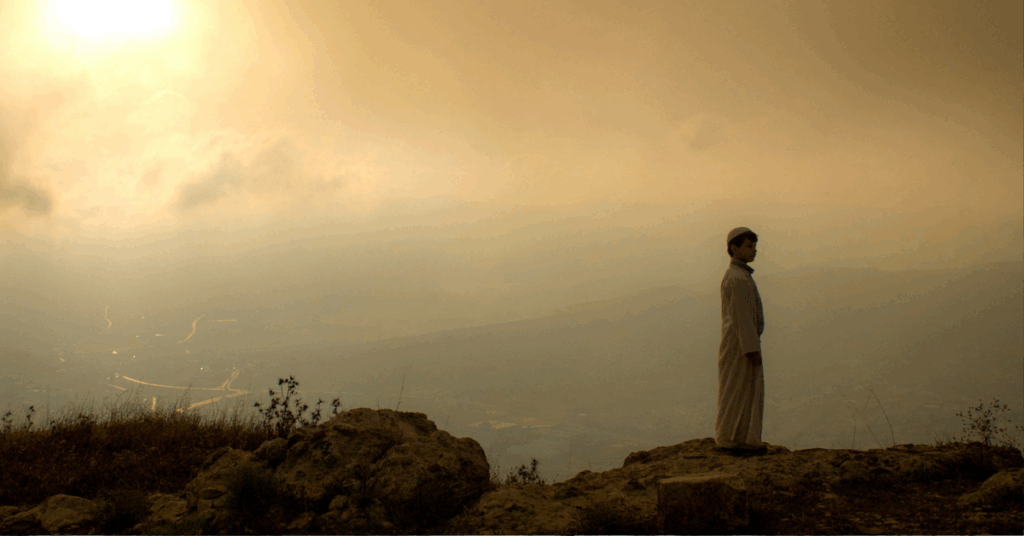
Gustavo Castro creates a pluralized and comprehensive portrait of the Palestinian people through the story of the Latiff family, made up of Palestinians and Brazilians. The documentary builds an informative timeline of the conflicts and reaches an extremely relevant conclusion about how the most video-recorded genocide in history can still be questioned or simply ignored amid the ocean of information on social media.
Review
In her video about the philosophical concept of death, British YouTuber Abigail Thorn talks about how, for a group or political entity to continue functioning normally, one must consider that the death of some people is not relevant. That they must, by nature, be eternally treated as “ungrievable.” She cites articles that directly state that “political power is the ability to decide which life matters.” These arguments emerge after she reveals that her video is, among other things, about what has been happening in Gaza since October 2023. The Palestinian question in the face of decades of Israeli occupation has become the focus of several videos like this, and also of films and documentaries such as “No Other Land,” winner of the 2025 Oscar, or “Palestine 36,” which fictionalizes an earlier moment in Palestinian history, before their forced displacement in the event now known as the Nakba.
With the heightened attention received by the actions of the Brazilian government after the beginning of this phase of the conflict, such as accusing the genocidal actions of Israeli forces and carrying out the rescue of Brazilian citizens in the region, space has opened up for a Brazilian perspective on the subject. It was to be expected that documentaries like “Notes On an Exile,” by Gustavo Castro, would begin to be produced. However, as the director himself informs in his narration during the film, this documentary began to be conceived in 2018, accompanying the excursion that a Christian group would make to the Holy Land and then head to the West Bank, where they would conduct interviews with the Latiff family, made up of Palestinians and Brazilians. Castro focuses somewhat on that family’s small farm, and from there begins to assemble an elaborate portrait of the Palestinian people, more pluralized than Western media would like to admit. At the same time, he creates a timeline of Palestine’s history and how the conflicts with Israel have developed over the years. Castro makes a point of remembering previous attempts to establish peace, and the role of figures from the Jewish community such as Yitzhak Rabin, Prime Minister of Israel between 1974 and 1977, and then between 1992 and 1995, when he was assassinated by a far-right Israeli Zionist who opposed the Oslo Accords. In addition to creating a more complete and informative image, it is a way of reinforcing that Zionism is far from being unanimous in the Jewish community even within Israel, which serves to silence some anti-Semitic opinions that unfortunately gained strength alongside the rejection of the expansionist project of Tel Aviv and Washington.
Unfortunately, the film suffers from some language problems. It is difficult to avoid comparing the styles of Gustavo Castro and Petra Costa, and not just because the director has recently gained much notoriety for her documentaries. Even the narration that Castro employs throughout the film somewhat resembles the way Petra expresses herself in her films, that calm, casual, and somewhat melancholic tone of voice. And in the same way, both directors place themselves as characters in their films, using a very personal perspective on the subject as a starting point. But Petra knows the moment when she should turn the camera away from herself. Castro inserts himself too much into the scene at times that don’t seem natural at all. He even includes scenes from his own childhood as a way of illustrating his own privilege, a comment so obvious it didn’t need to be mentioned. Not to mention two animation sequences that seem very out of place with the rest of the film.
However, these issues don’t really get in the way, being present more at the beginning of the film, before Castro realizes it’s better to let the facts speak for themselves. Moreover, any technical amateurism that a director might demonstrate in their first feature film pales in the face of the courage to address a subject like this at such a necessary moment. Even with another ceasefire recently announced (which the Israeli army is already disrespecting), there is still a long way to go before reaching anything resembling peace, and the horrors of recent years cannot be forgotten so easily. So, the more voices rise around the world against the genocide of the Palestinian people, the better. And more than that, Notes On an Exile still reaches an extremely relevant conclusion in its final moments. The film questions how it is possible that what is perhaps the most video-recorded genocide in history can still be questioned or simply ignored. The answer lies in the way information is consumed in the midst of social media, in the age of infinite content flow. The images of Gaza’s buildings in ruins must exist alongside everyday news, makeup tutorials, kitten videos, and intentional disinformation. It is much easier to ensure that a group of people remains ineluctable when the records of their deaths are diluted in an immeasurably vast ocean of information, albeit not at all deep.
Where to watch Notes On an Exile:
Coming soon
Credits
Director: Gustavo Castro
Screenplay: Juliana Sanson, Ticiano Monteiro, Gustavo Castro
Cinematography: Gustavo Castro
Editing: Ticiano Monteiro
Sound Design: Ulisses Galetto
Music: Grace Torres
Production Designer: Jonas Sanson
Production: Juliana Sanson, Gustavo Castro
Production Company: Fabulário Filmes
Format: Feature film / Documentary
Year: 2024
Country: Brazil
Language: Brazilian Portuguese