Why we recommend it
Ana Petta creates an intimate documentary about the threat to ways of life in São Paulo’s small urban villages. With a nostalgic gaze through her children’s perspective, the film defends spaces of calm and harmony amid real estate speculation and verticalization, making a relevant counterpoint between the dispossession of external environments and inner worlds.
Review
“My backyard is bigger than the world.”
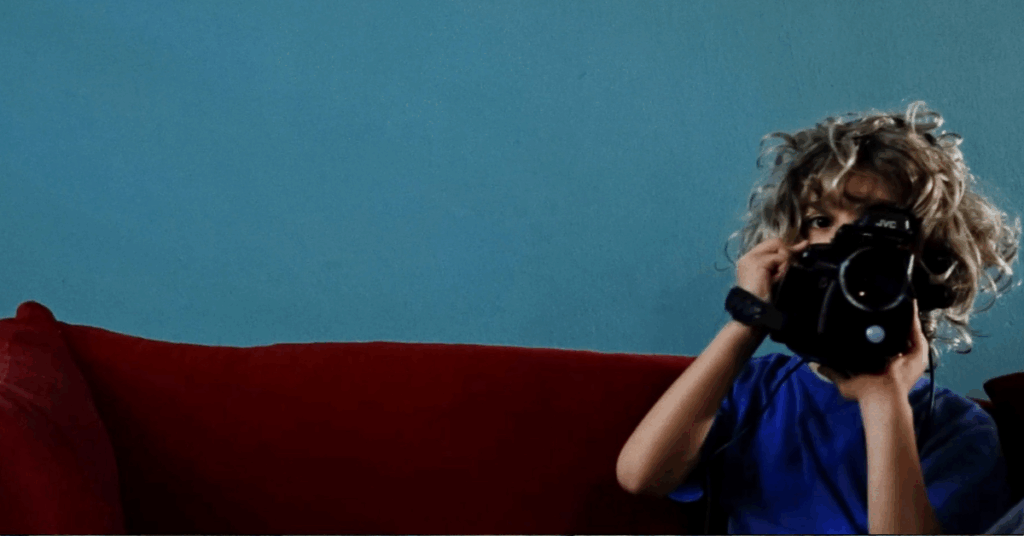
This verse written by Manoel de Barros appears on screen in the first seconds of Amora, a new documentary by Ana Petta. Next, we see images recorded by the camera of the director’s teenage children, Maria and Pedro, as they enter the house where they lived a few years ago inside a small village in the Vila Mariana neighborhood. The place is empty, already undergoing a process of dismantling. One of the first things that catches the eye are the words graffitied on a wall: “this house is 87 years old, has history, has memory, has soul, has love.” This sequence ends with Pedro asking his sister to hold the camera while he sits on the trunk of the mulberry tree in front of the house’s entrance. The film establishes there its main perspective, that of a young gaze, and yet, nostalgic.
However personal the account Ana Petta makes in this work, she still delves into an issue that affects us all. Through the images she recorded over the years she lived in that house, an appreciation emerges for a specific way of life that is currently threatened. Focusing on the period when Maria was ten years old and Pedro was four, she gives us the children’s point of view about that space, about the other residents of the village, about the city’s own history and small villages like that one. It is an experience based on calm and harmony, arriving home and feeling like you’re breathing better, something increasingly rare in the center of a city the size of São Paulo. But the director’s main objective is to narrate the events that unfolded at that time, and how that entire idyllic scenario was at risk. It begins with the sale of the property to a construction company, which like so many others is committed to the perpetual verticalization of large cities and real estate speculation.
From there, we see the reactions of neighbors and friends, who among their declarations of love for the village discuss strategies to prevent their homes from being expropriated. And we also see the negotiations with the construction company’s representatives, who treat the demolition of the place for the construction of yet another luxury condominium as inevitable. The director documents all of this with an intimate gaze, with the exception of a moment when she cuts to an advertisement for the future development. And the contrast is staggering between the images of real people living happy lives in houses that were made for people to live in and the tacky and artificial language that the real estate market employs to sell its fancy buildings that look more like giant table decorations. Aside from some inserts like that, Ana prefers to keep her focus on people, but always with the camera at a safe distance from events, emulating her children’s point of view – especially Pedro’s, who is practically the film’s protagonist.
In fact, it is possible to make a relevant reading about the way the director uses the image of her own children, creating a counterpoint to the recent discussion about adultification on social media. The topic gained attention due to concerns about what this type of exposure can cause for young people. Among other things, about adults appropriating their children’s images to generate profit. In “Amora,” this logic is inverted. Ana Petta frames her children in this closed format of a documentary, giving vehicle to their own opinions, and defending an environment that is, above all, distant from the digital medium and its most toxic elements. And more than that, this phenomenon of adultification is just another symptom of the growing information crisis, which makes us dependent on an uninterrupted flow of digital content, which has only made us more anxious and less attentive to the world around us. This phenomenon, alongside the housing crisis that the director accuses in this film (gentrification, speculation, verticalization) demonstrates how our basic need for a healthy and humane way of life is being disregarded on two different fronts. Both our external environments and our inner worlds are being dispossessed.
Where to watch Amora:

Credits
Direction: Ana Petta
Screenplay: Ana Petta, Paulo Celestino
Cinematography: Flora Dias
Editing: Paulo Celestino
Sound Design: Edson Secco
Music: Edson Secco
Production: Ana Petta
Production Company: Clementina Filmes
Format: Feature film / Documentary
Country: Brazil
Language: Portuguese