Why we recommend it
In her new documentary for Netflix, Petra Costa presents a thorough and essential analysis of how evangelical church lobbies shaped the rise of Brazil’s far-right. “Apocalypse in the Tropics” creates an almost sequel to “The Edge of Democracy,” this time focusing on the religious foundations of Bolsonarism and revealing pastor Silas Malafaia as the architect behind Bolsonaro’s messianic image. With meticulous research, Petra Costa exposes the political-religious agenda that infiltrated Brazilian politics and led to the January 8th coup attacks.
Review
It’s no news to say that the last years of the Brazilian political scene have been an emotional roller coaster. For everyone. Starting with the sequence of events that led to Dilma Rousseff’s impeachment and culminating in the coup attacks of January 8, 2023, the act of following the news became an exercise in anxiety management. Even for far-right supporters – or being more specific, for the heap of conspiracy theories, sociopathic behavior, and hatred toward minority groups that is Bolsonarism – this period was nothing less than completely stressful. Perhaps this, coinciding with this political group’s facility for detaching from reality, explains somewhat the cult mentality they adopted. In her new documentary for Netflix, director Petra Costa presents a better explanation.
There have been several recent documentaries that tried to make sense of this tumultuous period. “O Processo” by Maria Augusta Ramos focused on the incongruities and injustices of the coup that brought down Dilma. “O Muro” by Lula Buarque de Hollanda, with a more centrist tone, tried to address the growing polarization during the protests for and against the impeachment. And perhaps the most celebrated example comes from Petra Costa herself, in her previous collaboration with Netflix, “The Edge of Democracy,” a documentary nominated for an Oscar in 2020. And now, in “Apocalypse in the Tropics,” she creates almost a sequel to her previous film, this time focusing on a more specific facet of the Brazilian far-right’s rise: the extremely powerful evangelical church lobby and its influence on our politics. Because of this, and not just due to the director’s specific style, both documentaries share similar approaches, working to establish a timeline that reaches far back before the main period of their narrative (here, she starts talking about the very construction of Brasília). Less prominent in this new film are the personal intersections that Petra Costa explored in “The Edge of Democracy,” where she positioned herself much more as a character. In “Apocalypse in the Tropics,” she inserts herself mainly to admit her bias on the subject, as well as to acknowledge her blind spots. “My secular education wasn’t helping,” she says, when trying to understand how powerful neo-Pentecostal influence is over the electorate.
It’s a blind spot shared by much of the country’s more elitist left, which in recent decades began losing more and more ground among some of the most vulnerable portions of the population. The film manages to didactically explain how this happened. Starting with the offensive by North American religious lobbies during the 1970s, led by nefarious figures like televangelist Billy Graham, who sought to diminish the influence of Catholic priests and bishops in Brazilian society—those who adhered to Liberation Theology. This ideology was born in Latin America in the 1960s, defending that protecting the poorest and liberating the oppressed is a central part of Christ’s teachings, and thus should also be the greatest objective of Christian faith. The film illustrates this thinking by rescuing the famous phrase by Dom Hélder Câmara: “When I give food to the poor, they call me a saint. When I ask why they are poor, they call me a communist.” According to Petra’s research for the film, part of the US campaign against Brazilian political independence during the Cold War operated through this conversion of Brazilian congressmen via American manipulation that promoted “Christ and Capitalism in one package.” Thus, they began to oppose Liberation Theology, moved by something that would be its extreme opposite: dominionism, the belief that Christianity’s objective is not to heal social ills, but rather to infiltrate all spheres of society, with its leaders controlling them directly or indirectly based on their interpretations of biblical texts.
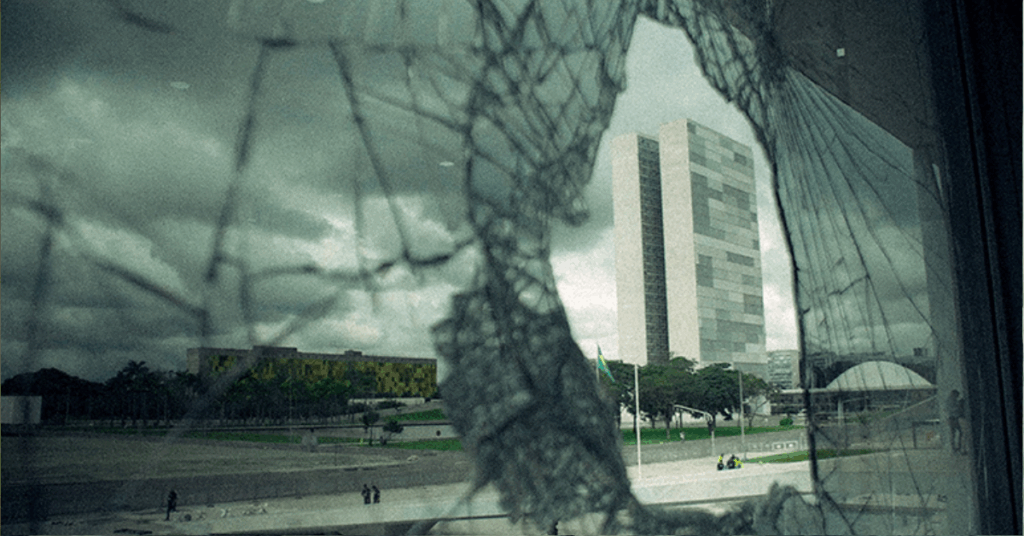
In this way, despite the film focusing on the period of Bolsonarism’s rise and the Bolsonaro government, Jair Messias himself cannot be considered the “protagonist” of this documentary. That role belongs to the eminence grise behind his government, the one who can be considered Brazil’s greatest lobbyist: pastor Silas Malafaia. Through archival footage, reports, and direct interviews, the timeline the film constructs reveals Malafaia, in all his egocentric tackiness, as the architect behind Bolsonaro’s messianic image, and how the demands of what he considers the interests of the “evangelical people” shaped the country’s direction. The worst consequences of this, in the context of four years of a government subordinate to big businessmen and millionaire pastors, was the catastrophic handling of the COVID-19 pandemic and, ultimately, the coup attacks in Brasília. And it brings some comfort that, while this text was being written, news broke that Silas Malafaia was indicted by the Federal Police in the investigation into the coup plot. But not much. The trauma this country went through still needs a lot of work to be healed. Therefore, “Apocalypse in the Tropics” chooses to end its narrative with images of the attacks, followed by Petra’s camera moving slowly among the wreckage. The director’s narration, with her calm and somber voice, concludes by affirming that those ruins symbolize the very objective of a democracy, which is to “protect the vulnerable from brute force.”
Where to watch Apocalypse in the Tropics:

Credits
Direction: Petra Costa
Screenplay: Petra Costa, Alessandra Orofino, David Barker, Nels Bangerter
Production Company: Busca Vida Filmes
Production: Petra Costa, Alessandra Orofino
Photography: João Atala, Pedro Urano, Murilo Salazar
Editing: Victor Miaciro, Jordana Berg, Tina Baz, David Barker, Nels Bangerter, Eduardo Gripa
Format: Documentary
Runtime: 110 minutes
Country: Brazil