Why we recommend it
Mariana Brennand approaches child abuse in Amazonian communities with notable cinematic sensitivity, choosing an ethical visual language that communicates without exploiting. With Jamilli Correa’s revelatory performance and Rômulo Braga’s complex work, the film discusses an urgent reality of Brazilian society through fiction, prioritizing care for its child cast and building a necessary narrative about a difficult subject.
Review
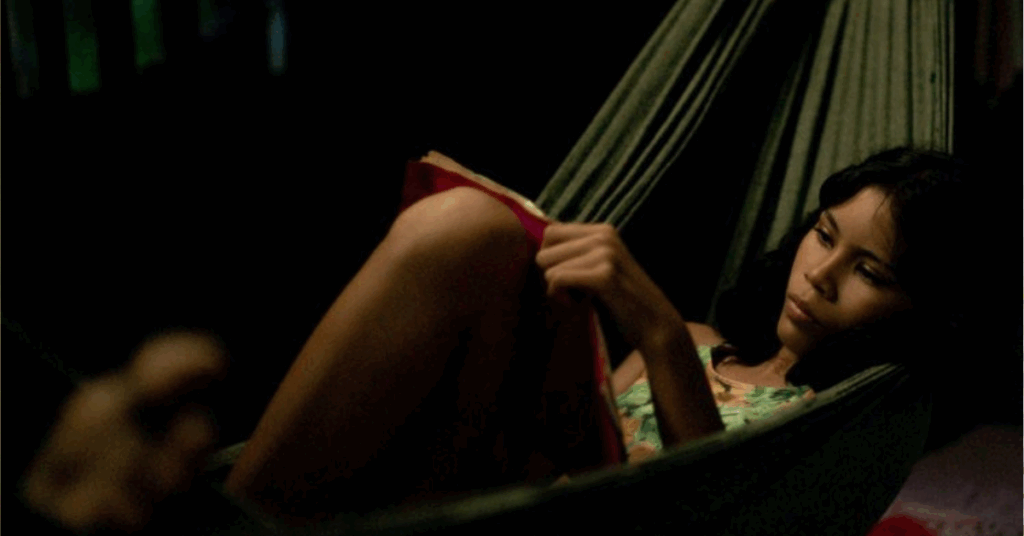
There are two moments in Manas, the new film by director Mariana Brennand, that reveal the sensitivity and subtlety with which she approaches her disturbing subject matter. In the first, the protagonist Marcielle, a thirteen-year-old girl, is with her school friends rehearsing some dance steps for a presentation. To the sound of an evangelical ballad, the moment is treated casually, appearing in the first half of the film while we are still following Marcielle’s routine in her community on Marajó Island. But this ordinary character of the scene creates a conflict in the viewer’s gaze, which automatically shifts from Marcielle dancing in the center of the stage and begins to focus on one of the other girls, who displays a large pregnant belly while following the choreography.
The other moment in question happens a little before the story’s turning point. Marcielle is swimming with her younger sister near the riverbank when their father decides to join them. Again, it seems like something casual. A normal manifestation of family joy. The father, Marcílio, covers his face with mud from the riverbed and pretends to be a monster for his daughters. Suddenly, the scene gains a disturbing atmosphere. The camera approaches Marcílio’s face as if revealing something, as if reality were altered a little. It lasts only a few seconds and nothing really happens. But our perspective on the character changes. Until then he seemed like an attentive family man. Severe, but affectionate, as much as possible in that precarious and laborious environment of Marajó’s inhabitants. The special attention he gave to Marcielle didn’t seem important. But from there, the film’s framing teaches us to fear something, and each new act by the character only reinforces this feeling. When the abuse finally begins, the tragedy is marked by everything but surprise.
Brennand had already revealed in some interviews that, before Manas was conceived, she had first approached the project thinking about making another documentary, a format she was already accustomed to. The motivation for this came from recent news about Marajó Island, which ended up becoming a topic of political dispute, marked by the spread of various fake news and real indignation about the child abuse reports that have afflicted Amazonian riverside communities for years.
However, the more she delved into the subject, the clearer it became to the director that fiction would be the best approach for this film, focusing on the point of view and core of a character who represents this entire dark situation on her own. A great example of this can already be observed in the film’s first frame, perhaps one of the most beautiful in recent Brazilian cinema. In it, we see Marcielle literally framed by a window frame. Looking from inside out, she appears surrounded by the wooden wall of her family’s shack and by the immensity of the Amazon waters. Again, the images communicate much more than text: this story is about this environment affecting this girl, and all girls like her.
It was precisely the format of a fictional drama that allowed Brennand to employ these visual nuances to the narrative. But this subtlety in choosing what to show and how to show it also serves another purpose, which is to maintain basic ethics when dealing with this subject alongside a cast composed of so many children. Still speaking about the film, Brennand revealed that the younger actresses didn’t get to read the complete script, and had special preparation for their scenes that didn’t expose them to the most terrible details of the story. And the result was obviously positive.
Among an entire cast that works very well – some of them established names – the children particularly present very strong performances. Jamilli Correa, who plays Marcielle, is a revelation. Her impactful presence and gaze convey so much. The perception that something inside the character dies when she begins to suffer abuse is disconcerting. There is something theatrical about her performance, in a good way. She delivers her lines with an intonation that highlights her, without removing her from that context of Amazonian realism. And her exchanges with her scene partners are evidence of this.
Especially with Rômulo Braga, who plays Marcílio with a complexity that doesn’t make the mistake of excusing his atrocities. It’s interesting that in the same year he shone with his role in Homem Com H, by Esmir Filho, he returns to cinemas playing another paternal figure who delves into destructive masculinity.
Reviewing all these factors, it’s possible to make a revealing comparison between Manas and another film that also deals with child abuse. Researching for this text, I was very much reminded of Pretty Baby, from 1978, directed by Louis Malle. The story is based on true accounts and the work of photographer E.J. Bellocq from Photographs From Storyville,The Red-Light District of New Orleans in the early 20th century. Like Manas, it also focuses on the point of view of a child on the verge of having her innocence corrupted: Violet, played by Brooke Shields, a twelve-year-old girl who was born in a brothel.
The abuse that Violet suffers, as well as the systematic way she begins to be displayed to the place’s patrons until her virginity is finally auctioned, are portrayed by the film’s text as horrible and shameful, in a tone of denunciation almost similar to Manas. But Malle’s camera says something else. Shields appears completely nude in several moments of the film, having her childish body framed in a blatantly appealing manner. Despite Brooke Shields not having bad memories of the production, it’s obvious that there wasn’t the same care that the actresses in Manas received. Pretty Baby condemns itself in the failure of this hypocrisy, with the shallow indignation of its text being betrayed by the visual language of an erotic film.
While Malle’s camera emulates the malicious gaze of one of his film’s pedophile characters, the triumph of Brennand’s camera in Manas is to choose an opposite perspective. If it were to represent the gaze of one of the characters, it would be that of Aretha, the public agent played by Dira Paes. She perceives the abuse happening and, above all, aims to save those girls. That’s why Brennand chooses not to show the act of sexual abuse on screen. Paes’ character doesn’t need to see to believe, putting into practice all the discussion of sisterhood displayed in feminist theories. She is, after all, one of the “manas” (Brazilian slang for sisters/female friends).
Where to watch Manas:

Credits
Direction: Marianna Brennand
Writer: Felipe Sholl, Marcelo Grabowsky, Marianna Brennand, Antonia Pellegrino, Camila Agustini and Carolina Benevides
Production: Inquietude
Coproduction: Globo Filmes, Canal Brasil, Pródigo and Fado Filmes (Portugal)
Distributor: Paris Filmes
Producers: Carolina Benevides and Marianna Brennand
Cast: Jamilli Correa, Fátima Macedo, Rômulo Braga, Dira Paes, Emilly Pantoja, Samira Eloá, Enzo Maia, Gabriel Rodrigues, Ingrid Trigueiro, Clébia Souza, Nena Inoue, Rodrigo Garcia
Cinematography and Camera: Pierre de Kerchove, ABC
Location Sound: Valéria Ferro
Editing: Isabela Monteiro de Castro
Art Direction: Marcos Pedroso
Costume Design: Kika Lopes
Makeup and Hair: Luiz Gaia
Sound Editing Supervision: Miriam Biderman, ABC
Sound Editing: Ricardo Reis, ABC
Sound Mixing: Armando Torres Jr., ABC
Casting Director: Anna Luiza Paes de Almeida
Acting Coach: René Guerra
Executive Production: Carolina Benevides and Marcelo Maximo
Associate Producers: Jean-Pierre and Luc Dardenne, Les Films du Fleuve, Delphine Tomson Dominique Welinski, Marcelo Pedrazzi, Braulio Mantovani, Felipe Sholl, Marcelo Grabowsky, Marcelo Maximo, VideoFilmes and Maria Carlota Bruno